

Designing with Seasons in Mind: The Slow Art of Ikebana
Craft of Meaning - Design led studio, surface patterns, photography, bespoke art, storytelling
THE ART OF CARE
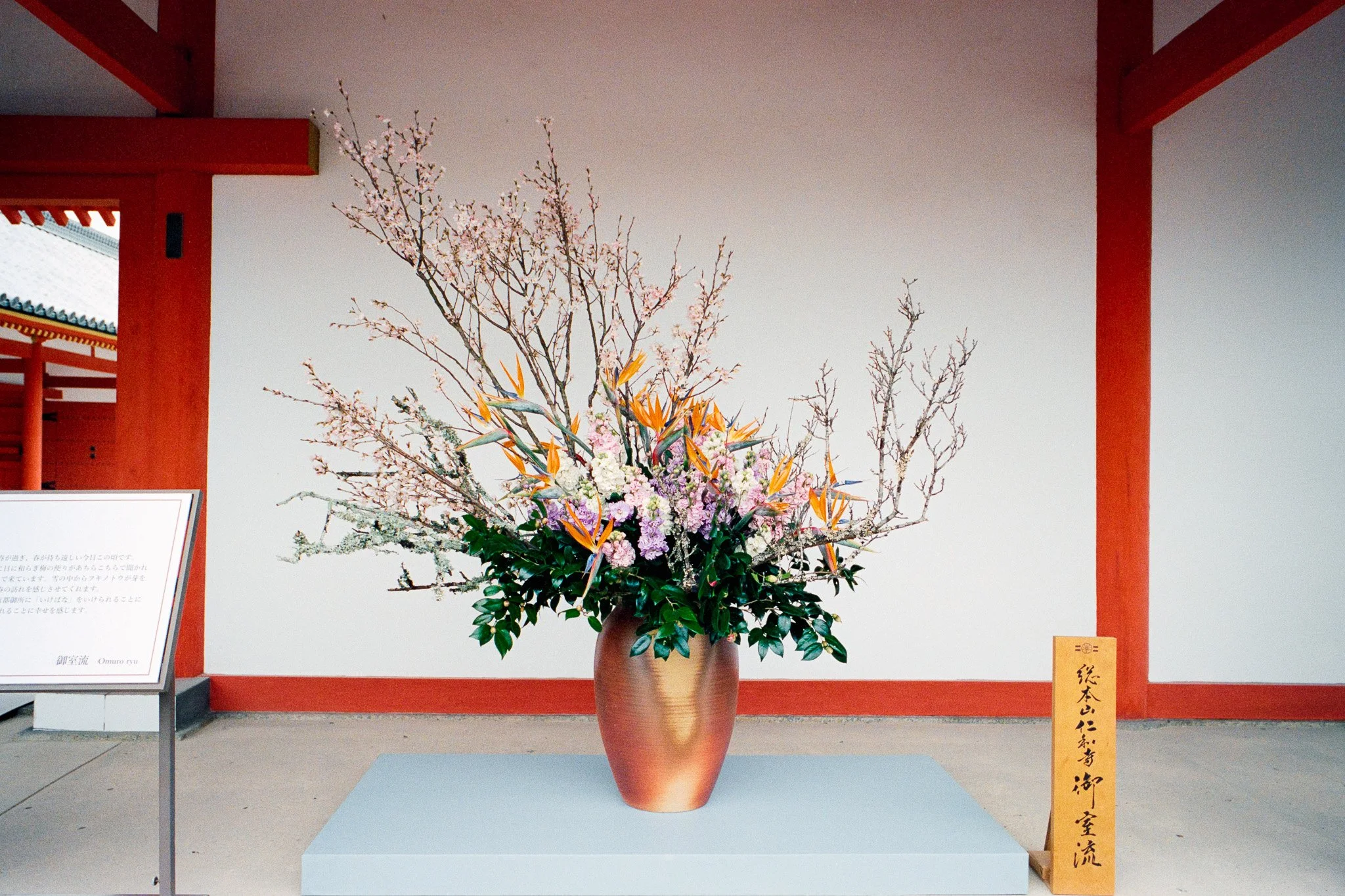
While a bunch of flowers in a vase brings its own pleasure, ikebana is an art form unlike any other. It asks for creativity and care—arranging nature’s elements in often unexpected ways and unusual containers. That alone is fascinating.
Ikebana is not just about the final arrangement—it’s about everything that happens before and around it. From knowing the characteristics of the plants, to applying the right water absorption techniques to extend the plant’s lifespan so it stays fresh and brings joy for as long as possible, to the delicate art of cutting. Take hollow-stemmed flowers like calla lilies—the stem must be rotated while cutting to avoid damaging the soft inner tissue.
Then there’s the art of stabilising and embedding additional natural elements: stubs of branches, twisted vines, stones, driftwood—any of which, if desired, can become an important part of the arrangement in its own right.
There are gentle bending, shaping, and trimming techniques—as if cutting through visual noise to reveal the pure presence of a single stem or branch, to bring forward its essence, gently and reverently.
There’s also the responsibility of providing an optimal environment to keep the flowers and plants healthy and vibrant—from temperature and humidity control, to finding opportunities to let flowers rest, at least at night or when no one is around to appreciate them.
While I didn’t know ikebana as an art form until later in life, I vividly remember, even as a child, how my mother would treat flowers with the utmost care. She would occasionally receive a bouquet of her favourite roses—short, pink-orange, thick-stemmed—and at night she would gently “put them to sleep” in the bathroom: stems cut at an angle and laid in cool water, away from the light. A quiet ritual of care. A daily act of devotion to keep the gift alive so it could brighten the space a little longer.
THE DEEPER MEANING
Ikebana is not only about having plants in their prime. It is a process of witnessing the evolution that these living, breathing elements go through each day. Just like in the life of a human being, there is beauty to be found in every stage. That alone feels so poetic to me.
Selecting the right container is just as important. With so much care behind each decision, it’s never an afterthought. Texture, scale, season, and occasion all offer opportunities to deepen meaning and mood.
It’s the creation of a wholesome experience, step by step, one small consideration at a time—all the way to pondering the reason for its existence, its relationship to the space, and its connection to a particular moment in time.
If it sounds like a lot—it doesn’t have to be. A single wildflower, thoughtfully placed, can be a complete arrangement. Holding meaning, presence, and quiet joy through its brief life.
Over time, I’ve come to realise how deeply these principles of ikebana shape not only how I see flowers, but how I create—with paint, thread, and words.
There is also, within ikebana, the opportunity to repurpose. To give a second life to an object. To see something familiar in a new light and enhance its meaning by using it within an arrangement, however unconventional it might feel. There are no boundaries for imagination and creative expression.
Ikebana is not just “nature in a vase.” It’s a transformed form—layered with new meaning in the process. In my view, it offers much more opportunity for self-expression than a traditional Western bouquet.
More time and thought might go into it, and with that, another level of connection with the elements evolves. It gives us the opportunity—maybe even for the first time—to see beauty not just in blooms, but in stems, leaves, branches, and roots. These are no longer just materials, but a means of expression.
In a world where “more” often equals “better,” ikebana invites us to embrace simplicity. To express more with less. And to avoid wasting life—including the lives of plants—mindlessly.
APPRECIATING THE SEASONS
Seasonality is another important aspect to mention. We live in a time where those natural boundaries are often blurred or erased by mass production and the forcing of nature to perform out of season—be it with fruits and vegetables, or flowers. Having access to everything all the time robs us of the opportunity to feel that sense of wonder when witnessing nature’s transitions.
There is real joy in living aligned with the seasons. Like the first sighting of daffodils in early spring—a joyful sign that the world has shifted. If they were available all year, they would lose their charm and meaning.
This connection to seasonality is very close to my heart and a guiding principle in many of my day-to-day decisions.
I often wonder how others connect with the seasons. Do you have your own quiet rituals—perhaps a dish, a scent, a walk—that marks the changing rhythm of time? I’d love to hear about it.
Observing seasonal changes and witnessing the transformation that nature brings each time is a beautiful practice. Tuning into the season through ikebana allows us to create special, grounded moments—rooted in presence and appreciation—whether it’s the quiet beauty of winter or the full abundance of summer.
Much like watching the birds return in spring or disappear into the hush of winter, ikebana teaches us to observe, to notice, and to honour transition.
Ikebana feels, to me, like an experience of the full life cycle—a quiet mirror of time, beauty, impermanence, and renewal. It reminds me not only of our connection to nature, but also serves as a deep well of inspiration in all the work I do.
Get in touch or join our mailing list to continue the conversation.